Different Types of Penetration Testing Approaches
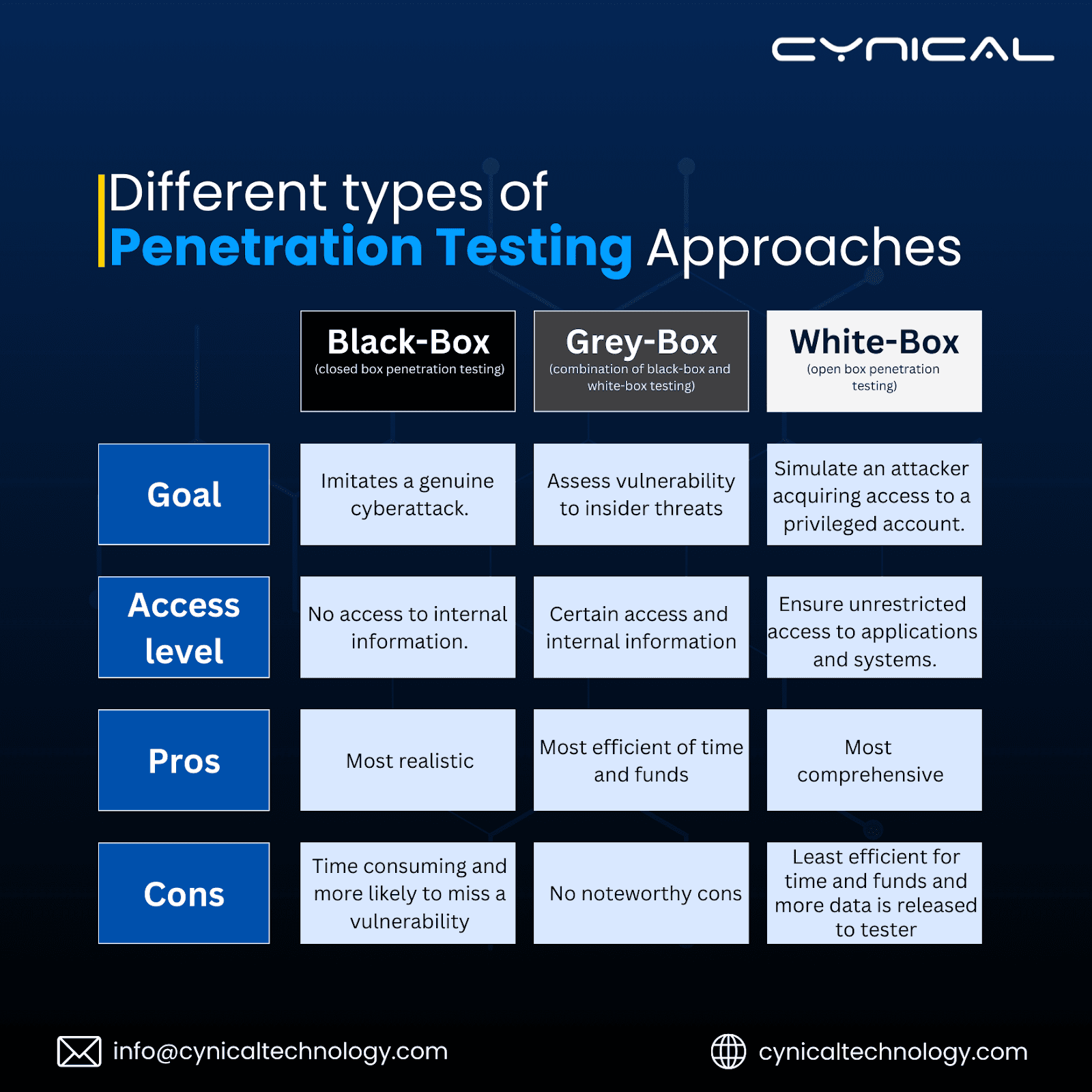
Different Types of Penetration Testing Approaches
Penetration testing, also known as "pen testing," is a simulated cyberattack conducted to evaluate the security of a computer system, network, or application. This testing helps organizations identify potential vulnerabilities before malicious attackers can exploit them. There are three primary approaches to penetration testing: Black-Box, Grey-Box, and White-Box. Each approach offers unique insights into security weaknesses and strengths. In this blog, we'll explore these different types in detail, highlighting their goals, access levels, pros, and cons.
1. Black-Box Penetration Testing
What is Black-Box Testing?
Black-Box penetration testing, also referred to as closed-box testing, is an approach where the tester has no prior knowledge of the internal structure, code, or system. The tester only knows what is publicly available, just like a real-world attacker.
Goal
The main objective is to simulate an external cyberattack without any internal knowledge. It aims to imitate the methods a genuine attacker would use to breach the system's defenses.
Access Level
Black-Box testing involves zero access to the internal structure, configuration, or source code of the target system. The tester only has the information that an outsider would have.
Pros
- Most Realistic: It closely mimics how real attackers operate, providing insights into the vulnerabilities that may be exploited by external threats.
Cons
- Time-Consuming and Prone to Miss Vulnerabilities: Since the tester has no access to internal information, identifying vulnerabilities may take longer, and some might remain undetected.
2. Grey-Box Penetration Testing
What is Grey-Box Testing?
Grey-Box penetration testing is a combination of Black-Box and White-Box testing. In this approach, the tester has limited knowledge of the internal structure and some access to the system. It's an intermediary level of testing where the tester knows more than an outsider but less than an insider.
Goal
The goal is to assess how a vulnerability could be exploited by someone with limited or partial insider knowledge, such as a disgruntled employee or a contractor.
Access Level
Grey-Box testing involves some access to the system’s internal structures and information. The tester might have certain credentials, knowledge of the architecture, or limited access to the system.
Pros
- Efficient Use of Time and Resources: It is more time-efficient than Black-Box testing, as the tester has some guidance and information. This also reduces the cost associated with prolonged testing.
Cons
- No Noteworthy Cons: Grey-Box testing strikes a balance between thoroughness and efficiency, making it suitable for most organizations.
3. White-Box Penetration Testing
What is White-Box Testing?
White-Box penetration testing, also known as open-box testing, is a comprehensive approach where the tester has full access to the system. This includes details about the internal architecture, source code, and even passwords or credentials.
Goal
The objective is to simulate an attack by someone who has obtained access to a privileged account or has insider knowledge, such as a system administrator.
Access Level
White-Box testing provides the tester unrestricted access to the applications, systems, and source code. This makes it the most detailed and extensive form of penetration testing.
Pros
- Most Comprehensive: Since the tester has full access, they can identify even the most hidden vulnerabilities and test the system thoroughly.
Cons
- Least Efficient in Terms of Time and Cost: Due to the depth of testing, it can be time-consuming and expensive. Moreover, sharing extensive information with the tester may introduce a security risk if not handled properly.
Which Penetration Testing Approach Should You Choose?

Choosing the right penetration testing approach depends on your organization's goals and current security posture. Here’s a quick guide to help you decide:
- Choose Black-Box Testing if you want to understand how vulnerable your system is to an external attacker with no prior knowledge of your infrastructure.
- Choose Grey-Box Testing if you’re interested in assessing risks associated with insider threats or third-party vendors who might have some access to your systems.
- Choose White-Box Testing if you aim for a thorough analysis and have the resources to conduct in-depth testing of your systems, or if you're concerned about vulnerabilities that could be exploited by someone with insider knowledge.
Conclusion
Each penetration testing approach serves its purpose in enhancing an organization’s security. While Black-Box testing is suitable for understanding the external threat landscape, Grey-Box offers a middle ground by evaluating risks from semi-privileged attackers. White-Box testing, though comprehensive, requires more time and resources but provides the most extensive vulnerability assessment. An organization should consider using a combination of these approaches to ensure a well-rounded security posture.
By understanding these different approaches, businesses can better decide which testing type fits their security needs and budget. Employing the right type of penetration testing can help in identifying weaknesses before attackers do, thus preventing potential security breaches.
For professional penetration testing services, reach out to Cynical Technology at info@cynicaltechnology.com. Stay secure!